Guides
The evolution of artificial intelligence
From Alan Turing's question to the assistants we use today: a simple journey through more than seventy years of artificial intelligence, with its breakthroughs, disappointments and fresh starts.

Today we talk to virtual assistants, translate texts in seconds and get writing suggestions on our phones. It can feel as if artificial intelligence (AI) arrived overnight, but it actually has a history of more than seventy years, full of big promises, disappointments and fresh starts. Knowing that journey helps us understand what AI can really do, what it still cannot do and why so much has changed in recent years.
So what is artificial intelligence?
Put simply, artificial intelligence is the field of computing that tries to get machines to carry out tasks that would require intelligence if people did them: understanding language, recognising images, making decisions or learning from experience.
It is not a single technology but a family of techniques that has grown over time. A good way to picture it is as a set of circles, one inside the other.
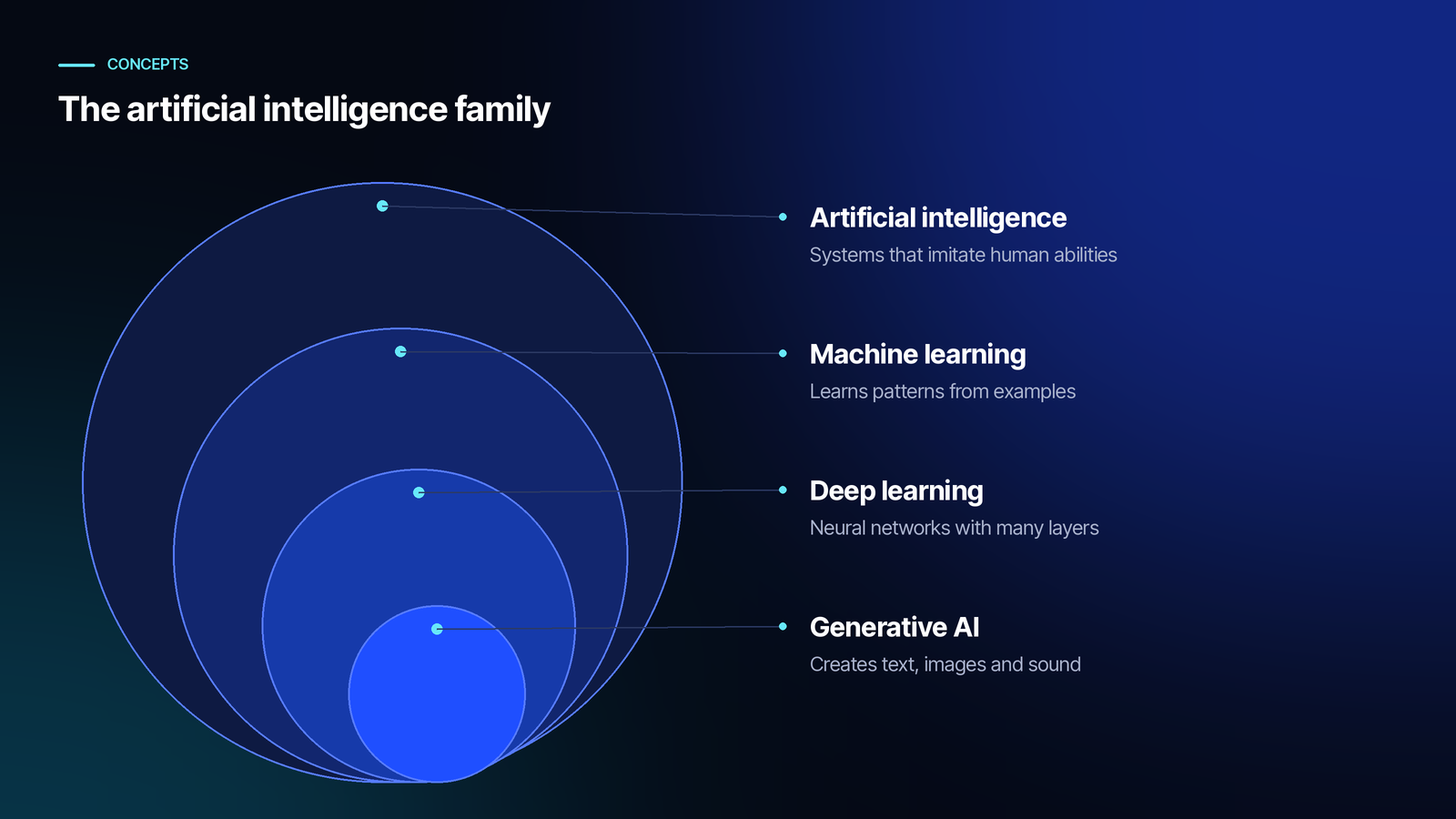
Artificial intelligence is the largest circle: any system that imitates human abilities, including programs based on hand-written rules.
Machine learning covers systems that learn patterns from examples instead of only following fixed rules.
Deep learning uses neural networks with many layers, very loosely inspired by the brain, and underpins today's speech and image recognition.
Generative AI can produce new content, such as text, images or audio, from a request written in everyday language.
The first steps: can a machine think?
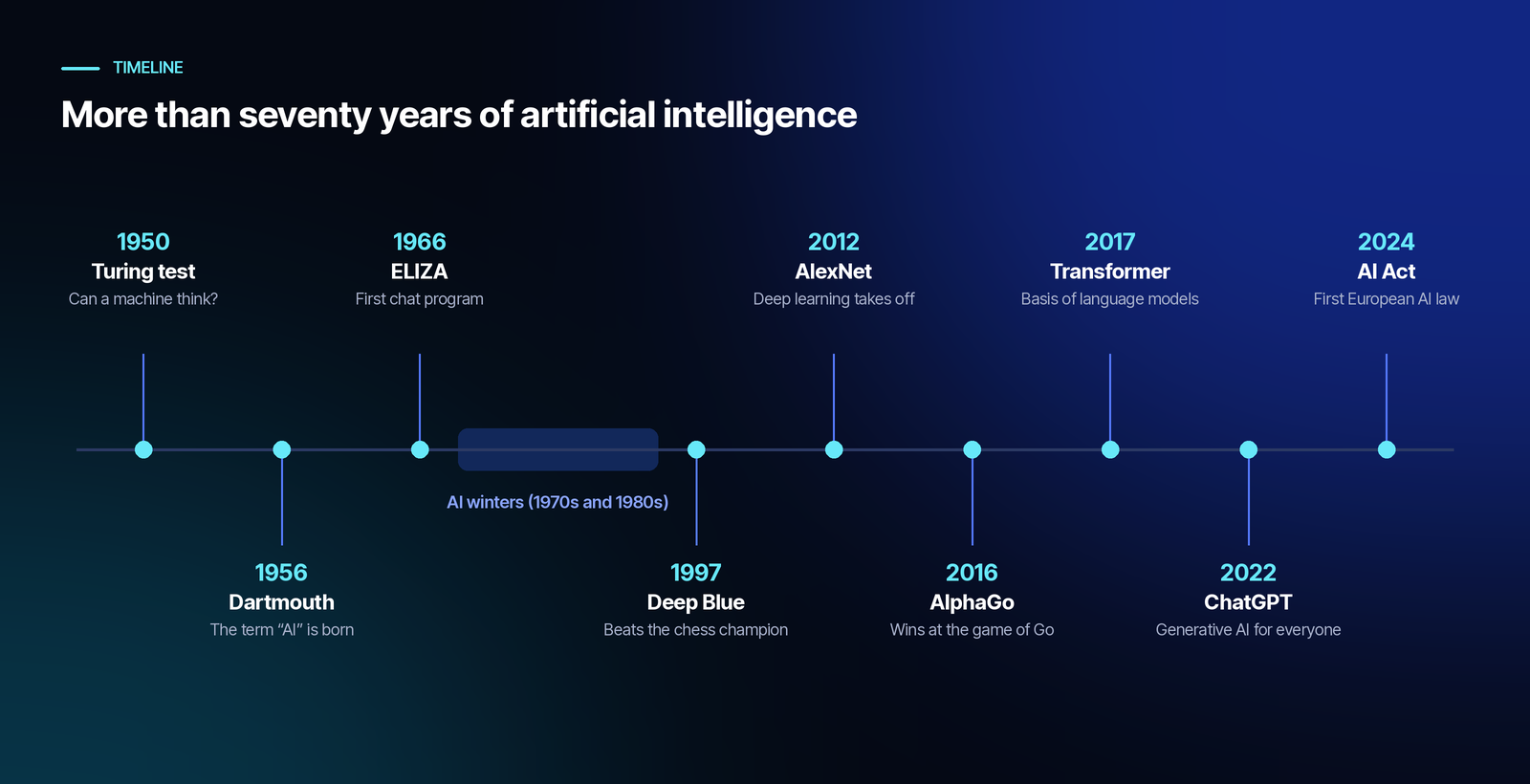
In 1950, the British mathematician Alan Turing published a paper asking a provocative question: can machines think? To avoid philosophical debates, he proposed a practical test, now known as the "Turing test": if a person chatting in writing cannot tell a machine from a human being, then the machine is behaving intelligently.
Six years later, in 1956, a group of researchers met at Dartmouth College in the United States and used the term "artificial intelligence" for the first time to name the new field. Optimism ran high: many believed that within a generation machines would have human-like abilities.
Over the following decades, programs appeared that could solve logic problems, play draughts or hold simple conversations. In 1966, ELIZA imitated a therapist using rules that turned the user's sentences back into questions. It was a clever trick, but there was no real understanding behind it.
The AI "winters"
The early promises turned out to be far too ambitious. Computers at the time had little memory and little processing power, and there was very little digital data available. When results failed to arrive at the pace announced, funding dropped and enthusiasm cooled. These periods, in the 1970s and again in the late 1980s, became known as the "AI winters".
Between those winters came a spring: expert systems. These programs gathered hundreds of "if this happens, then do that" rules, written with the help of specialists, for example to support diagnoses or configure equipment. They worked well on narrowly defined problems, but they were expensive to maintain and failed when faced with situations nobody had foreseen.
The big change was not teaching machines rules, but letting them learn from examples.
Learning from data
From the 1990s onwards, the approach changed. Instead of trying to write every rule by hand, researchers began building systems that find patterns in large numbers of examples. That is how a spam filter works: after seeing thousands of labelled messages, it learns by itself to recognise unwanted ones.
In 1997, IBM's Deep Blue computer beat the world chess champion Garry Kasparov. It was a symbolic moment, although Deep Blue won mainly through brute force, evaluating millions of moves per second.
Three ingredients, maturing at the same time, paved the way for the next phase:
Data: the internet, mobile phones and the digitisation of services produced more information than ever before.
Computing power: graphics processors, designed for video games, turned out to be ideal for training neural networks.
Better algorithms: new techniques made it possible to train networks with many layers effectively.
The deep learning revolution
In 2012, a neural network called AlexNet won an international image recognition competition by a wide margin. It was the sign that deep learning worked in practice. Within a few years, speech recognition, machine translation and identifying objects in photographs improved dramatically.
In 2016, DeepMind's AlphaGo beat one of the world's best players of Go, a board game with so many possible moves that brute force is not enough. The system learnt by studying games and playing millions of times against itself.
The era of generative AI
In 2017, Google researchers presented the transformer architecture, a new way for neural networks to process text by paying attention to how every word in a sentence relates to the others. This idea is the foundation of large language models, trained on vast amounts of text to predict, word by word, the most likely continuation.
In November 2022, the launch of ChatGPT put this technology in the hands of the general public. For the first time, anyone could ask a machine, in everyday language, to summarise a document, draft an email or explain a concept. Many other assistants and models followed, able to work with images, sound and documents as well.
More recently, attention has turned to systems that do not just answer but also look up information, use tools and carry out the steps of a task: the so-called AI agents. For them to do so safely, they must be connected to the right systems, with clear rules about what they may consult and what requires human approval.
The big picture
| Period | Main idea | Example |
|---|---|---|
| 1950–1970 | Symbolic reasoning and logical rules | Logic programs and ELIZA |
| 1970–1990 | Specialist knowledge encoded as rules | Expert systems |
| 1990–2010 | Machine learning from data | Spam filters, Deep Blue |
| 2010–2020 | Deep learning with neural networks | Image and speech recognition, AlphaGo |
| 2020–today | Generative AI and agents | Conversational assistants, summarising and drafting documents |
What AI still is not
Despite the progress, it pays to keep our feet on the ground. Today's models are very good at finding patterns and producing convincing text, but:
They can be confidently wrong. They sometimes invent facts or references, a phenomenon known as "hallucination". That is why important answers should be checked.
They do not understand the world as we do. They have no experience, intentions or common sense in the human sense.
They reflect the data they were trained on, including any biases and gaps.
This is also why regulation has become important. In 2024, the European Union adopted the Artificial Intelligence Act, the world's first comprehensive legal framework for this technology, which sets rules in proportion to the risk of each use.
What next?
The history of AI shows that progress is rarely a straight line. There have been exaggerated booms and unfair disappointments. What has changed in the last decade is that the technology has become useful in the daily lives of people and organisations, especially when combined with the right information and human oversight.
At Datapoint, we believe AI's greatest value lies in connecting it safely to the systems and documents organisations already use, with people approving what matters and processing kept within the European Union through our partners.