Guides
The benefits of artificial intelligence in public administration
From citizen services to document management, AI can free up staff time for the work that needs people. See where it can help, what care it requires and how to take the first steps.

Anyone who works in public administration knows the picture well: requests arriving through several channels, documents scattered across different systems, regulations that change and teams that do not always grow at the pace of the work. Artificial intelligence (AI) does not solve everything, but it can free up time for what really needs people: listening, deciding and following up.
In this article we set out, in simple terms, where AI can benefit public services, what care it requires and how to take the first steps.
Why now?
For many years, AI meant long projects, large volumes of organised data and specialist teams. The latest language models have changed that: they understand requests written in everyday language, read long documents and draft clear answers. When connected safely to the systems a service already uses, they can help with daily work without having to replace those systems.
At the same time, Portugal and the European Union have issued guidance so that this adoption is done carefully. The Portuguese Agency for Administrative Modernisation (Agência para a Modernização Administrativa, AMA) has published a guide to ethical, transparent and responsible AI in public administration, and the National Artificial Intelligence Agenda sets the country's priorities up to 2030.
Six areas where AI can help
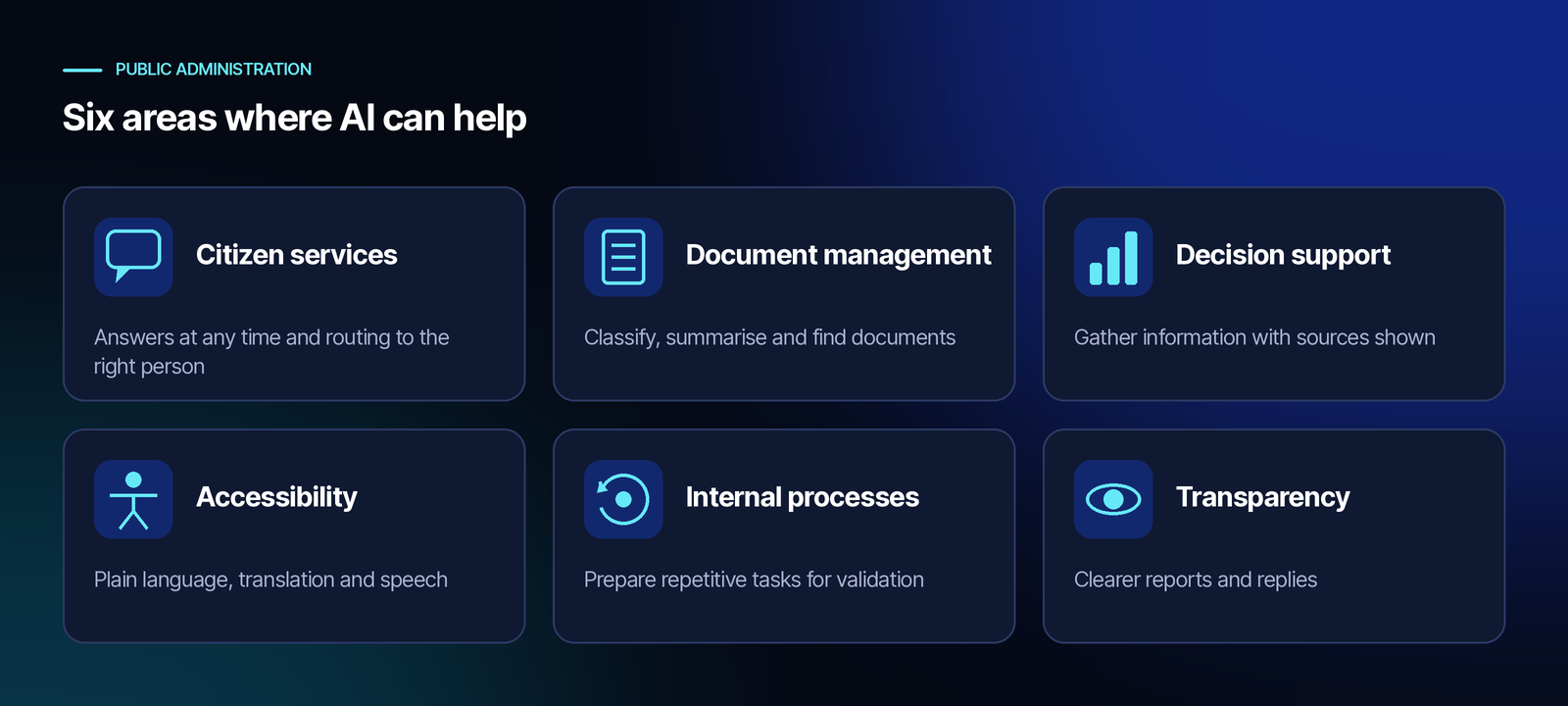
1. Citizen services
An assistant can answer the most frequent questions at any time of day, such as opening hours, required documents or the status of an application, and pass more complex cases to the right person together with a summary of the situation. Citizens wait less and staff receive better-prepared cases.
2. Document management
Letters, applications, opinions and regulations pile up every day. AI can classify documents as they arrive, extract the key information, find similar cases and prepare summaries, saving hours of reading and searching.
3. Decision support
Before deciding, information has to be gathered from several sources. An assistant can bring the relevant data together, compare it with previous cases and present a reasoned draft, showing where each piece of information comes from. The decision remains with whoever has the authority to take it.
4. Accessibility and inclusion
AI makes it easier to rewrite administrative texts in plain language, translate them into other languages and convert between text and speech. This helps disabled people, older people and foreign residents understand and use public services.
5. Internal processes
Much of a team's time goes on repetitive tasks: filling in forms from other documents, preparing periodic reports or checking whether an application is complete. AI can prepare these tasks so that people only need to review and validate them.
6. Transparency
Reports, open data and answers to information requests can be prepared more quickly and clearly, making public activity easier for citizens to follow.
An example: answering an information request
Imagine an information request about a public support scheme arriving by email. Today, someone has to read it, work out what it is about, look up the applicable regulation, check the case in another system and write the reply. With an AI assistant connected to those systems, the journey can be different.
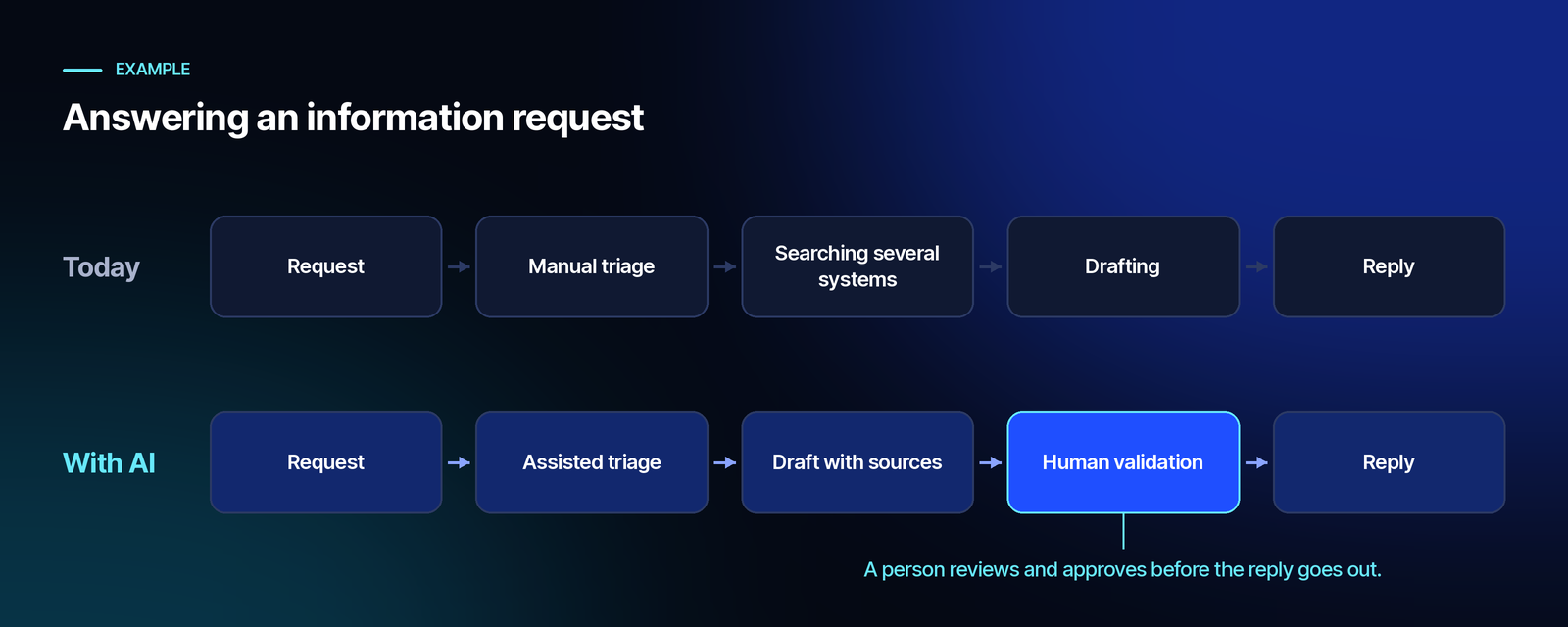
The assistant identifies the subject, gathers the regulation and the case information and proposes a draft with its sources listed. The member of staff reviews it, corrects it if needed and sends it. Nothing goes out without human approval.
The aim is not to replace the people who work in public services, but to give them more time for people.
Example uses and the role of people
| Use | Expected benefit | Role of people |
|---|---|---|
| Triage of requests and emails | Faster routing to the right department | Confirm the classification of unclear cases |
| Summaries of cases and documents | Less reading time before deciding | Check the original whenever necessary |
| Drafting replies and letters | Faster, more consistent replies | Review, adjust and sign |
| Searching internal regulations | Find the applicable rule in seconds | Validate the interpretation |
| Plain language and translation | Services that are more accessible to everyone | Ensure the text remains legally accurate |
The care required
The public sector has special responsibilities: it handles personal data, takes decisions that affect people's rights and must be accountable. AI adoption should therefore follow a few precautions:
Human oversight: AI prepares and suggests, but decisions affecting citizens are taken by people.
Data protection: comply with the GDPR, use only the data needed and make sure processing takes place in the European Union.
Transparency: tell citizens when they are interacting with an AI system and explain how it works.
Fairness: check that the system does not treat groups of people differently without justification.
Legal compliance: the European AI Act classes some uses as high-risk, such as those that influence access to public benefits, and these will be subject to stricter rules.
Security: treat AI systems like any other critical system, with controlled access and a log of every action.
How to get started
Choose a concrete, high-volume process, such as triaging requests or searching regulations.
Involve teams from the start. They know the real problems and they are the ones who will use the solution.
Start small, with a time-limited proof of concept and clear objectives.
Measure and adjust, listening to the people who use the system before extending it to other departments.
Invest in training, so that everyone can use AI with confidence and a critical eye.
Public services closer to people
Used well, AI can make public administration faster, more accessible and more transparent without losing what sets it apart: accountability to citizens. The key is to start carefully, keep people at the centre and choose solutions that integrate with existing systems.
At Datapoint, we have worked with regional public administration on information systems since 2017. Today, we help connect AI to those systems, with human approval for important actions and processing in the European Union through our partners.